Top talent has early-bird pricing.

The most valuable hire of the next 12 months might already be on someone's reject pile. A polymath whose value doesn't fit a role profile. A specialist whose excellence is invisible to generalist recruiters. A career-pivoter whose pedigree doesn't match their capability.

Heimdall surfaces them.

Legacy hiring tools test who the candidate was.
Not who they will be.

AI is changing what work looks like. Skills and role profiles that defined a role last quarter often don't fit it now. The candidates who'll matter most aren't the ones whose CVs match a current template - they're the ones whose underlying capacity compounds with whatever tools come next. Even if they haven't been exposed to those tools yet.

Removing a wrong hire fast still costs a month's pay - and that's the cheap part. The right one - the leverage-producer - could be 10-100x more valuable as AI compounds.

Heimdall measures it as AI Potential - a single score for who'll create value as AI compounds. Built from real evidence, with confidence floors that distinguish what's proven from what's likely.
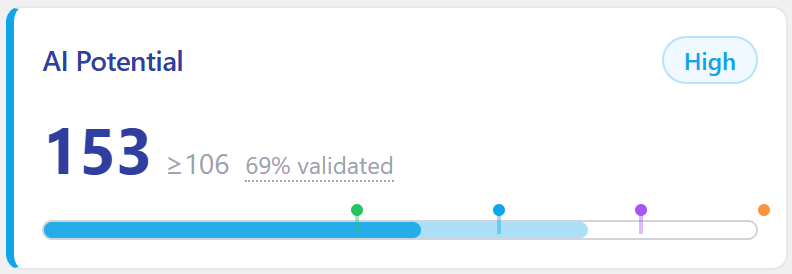
AI Potential score widget showing 181 ≥ 127, 70% validated, with 'Extreme' label badge. The horizontal bar visualizes both the validated floor (solid purple) and the potential extension (lighter purple), making the dual scoring gap visible at a glance.

Every score has two layers:

Potential: what the evidence suggests.

Floor: what can be defensibly proven.

The gap tells you what's worth validating, and how much of a gamble the upside is.

Knowing the overall capability only gets you so far. Heimdall characterizes the shape of the profile and what it offers.


A self-directed system evaluator who builds tools to test whether things actually work as assumed - a capability that becomes critical as organizations depend on AI systems they can't easily inspect.
An institution builder whose capacity to create durable systems that multiply others becomes premium as AI commoditizes routine technical work.
A multi-jurisdictional bridge-builder whose capacity to translate AI concepts across regulators, publics, and cultures becomes premium as organizations navigate AI-era governance complexity globally.
An early-career AI practitioner whose consistent pattern of self-directed initiative and shipping deployed results suggests a profile that will compound in value as AI tools lower the barrier between intention and execution.
A behavioral systems architect whose ability to see through human dynamics, challenge foundational assumptions, and build frameworks from cross-domain synthesis represents exactly the kind of durable human judgment that becomes premium as AI commoditizes routine analytical work.

Two paths reach high AI Potential: strong AI capabilities, or strong human judgment that becomes more valuable in the AI era. The strongest profiles combine both.

The score is the headline. The shape underneath is where the decisions get made.
Try Heimdall on people you already know well.

Start where you can verify. Watch for what surprises you anyway.

Start Free Trial

5 free assessments on current employees · 25 free on applicants · No credit card · No demo required

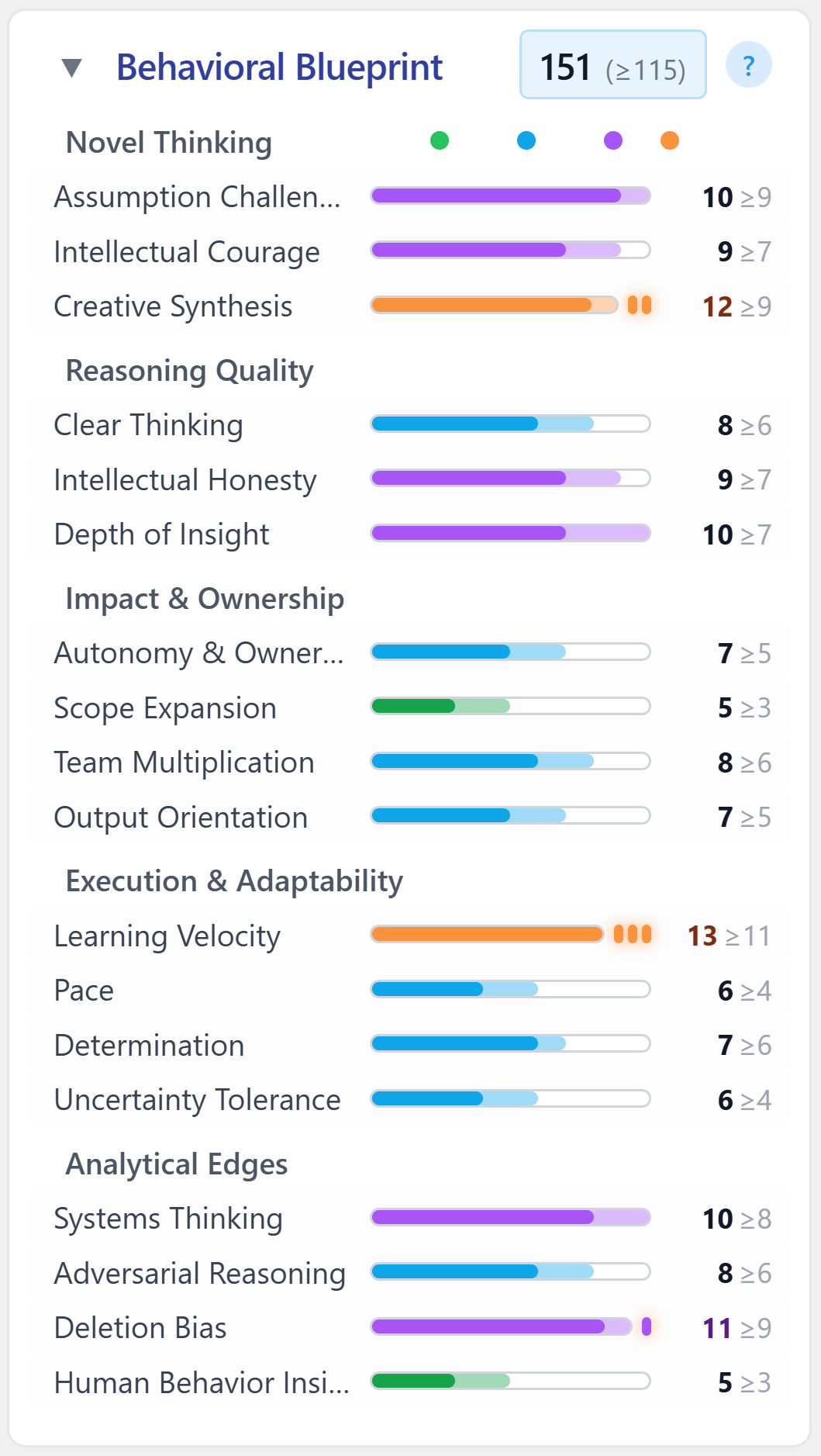
Behavioral Blueprint showing 18 traits across five categories - Novel Thinking, Reasoning Quality, Impact and Ownership, Execution and Adaptability, Analytical Edges - each scored with potential and floor values and color-coded by tier.
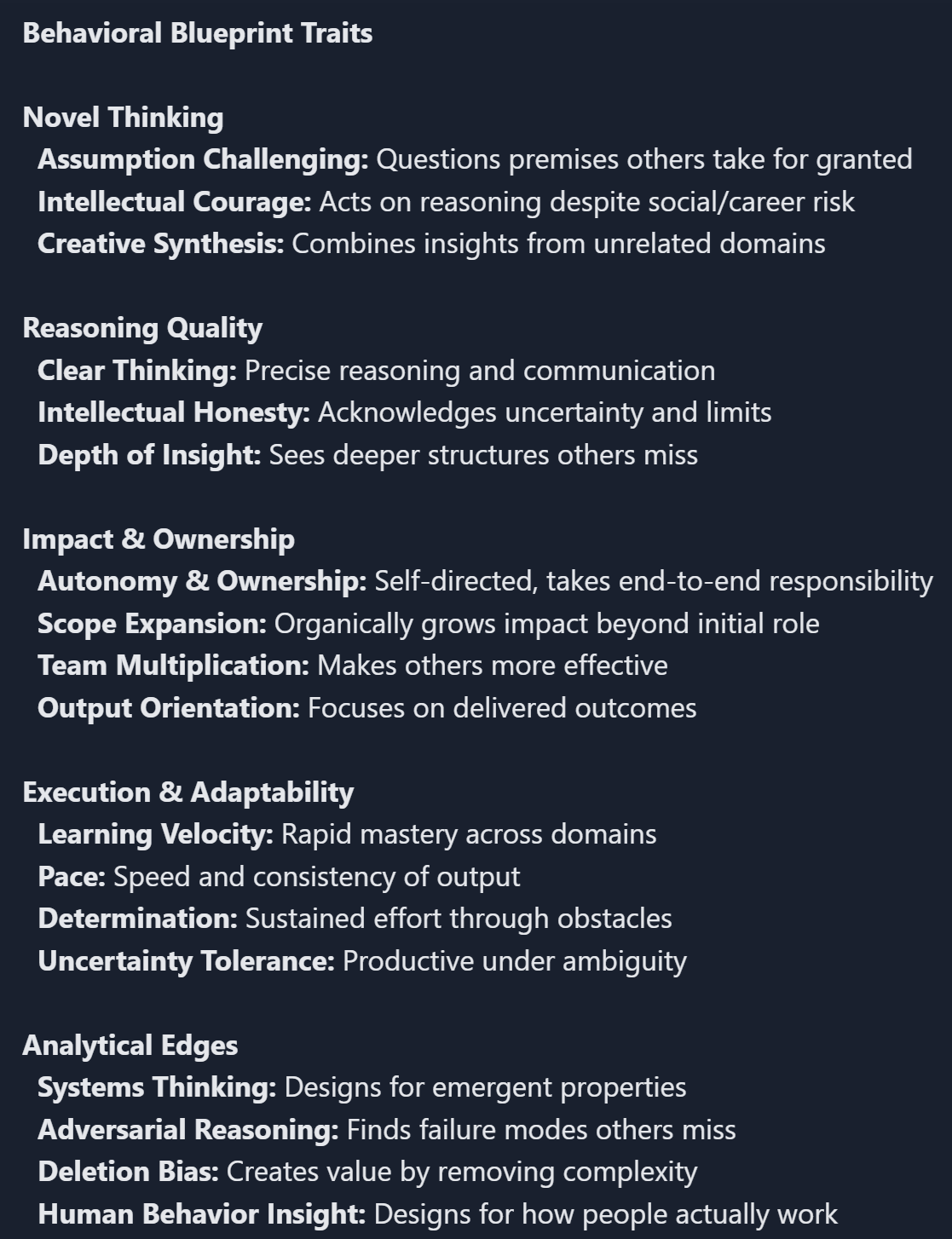
Trait dictionary listing all 18 Behavioral Blueprint traits grouped by category, each with a one-line definition. Examples: Assumption Challenging - Questions premises others take for granted. Creative Synthesis - Combines insights from unrelated domains. Adversarial Reasoning - Finds failure modes others miss.

Where does your company stand on each of these? You probably know better than you think.
The answer usually surfaces both a defining strength and a real blind spot.

Calibration Scale

3-5   Capable professional

6-8   Significant strength · Top 10% in field

9-11   Exceptional · Top 1% in field

12-15   World-class · Extreme outlier

You'll notice Heimdall's scales provide poor nuance for degrees of "below average." Opposite most scales, 80% is dedicated to gradations of excellence.

These aren't personality dispositions

"Assumption Challenging" doesn't mean someone is contrarian. It means there's evidence in their work history of questioning premises others take for granted. "Systems Thinking" doesn't mean they like diagrams. It means they design for emergent properties, and Heimdall can show where they did it.

Every score is derived from what someone has actually done, not what they say about themselves.

Heimdall helps you find candidates with the strengths your team is missing - and helps you see those gaps more clearly in the first place.

Has conformity become a problem at your company? Look for high scores on Assumption ChallengingAssumption Challenging: Questions premises others take for granted, Intellectual CourageIntellectual Courage: Acts on reasoning despite social/career risk, and Output OrientationOutput Orientation: Focuses on delivered outcomes.

Plus, depending on what else matters:

  • Doing it with strong interpersonal skills: Human Behavior InsightHuman Behavior Insight: Designs for how people actually work and Team MultiplicationTeam Multiplication: Makes others more effective
  • Challenging complexity to achieve simplicity: Deletion BiasDeletion Bias: Creates value by removing complexity
  • Security mindset and seeing how things can fail: Adversarial ReasoningAdversarial Reasoning: Finds failure modes others miss
  • Strong reasoning and analytical rigor: Clear ThinkingClear Thinking: Precise reasoning and communication
  • Seeing further ahead in second and third-order consequences: Depth of InsightDepth of Insight: Sees deeper structures others miss
  • Challenging their own ideas to find the flaws: Intellectual HonestyIntellectual Honesty: Acknowledges uncertainty and limits

If you've ever played a sports manager game, you've worked with deep quantitative profiles - the multi-dimensional view that lets you see what your team is missing, and then find the hidden gem who fills that specific gap.

Imagine playing one of those games and being told only "8 years experience in left field" and "was on these teams." Low-stakes hobby decisions don't get made on signals that thin.

When AI handles execution, the traits that differentiate are judgment, creativity, and the ability to see what others miss. These are exactly what Heimdall measures.
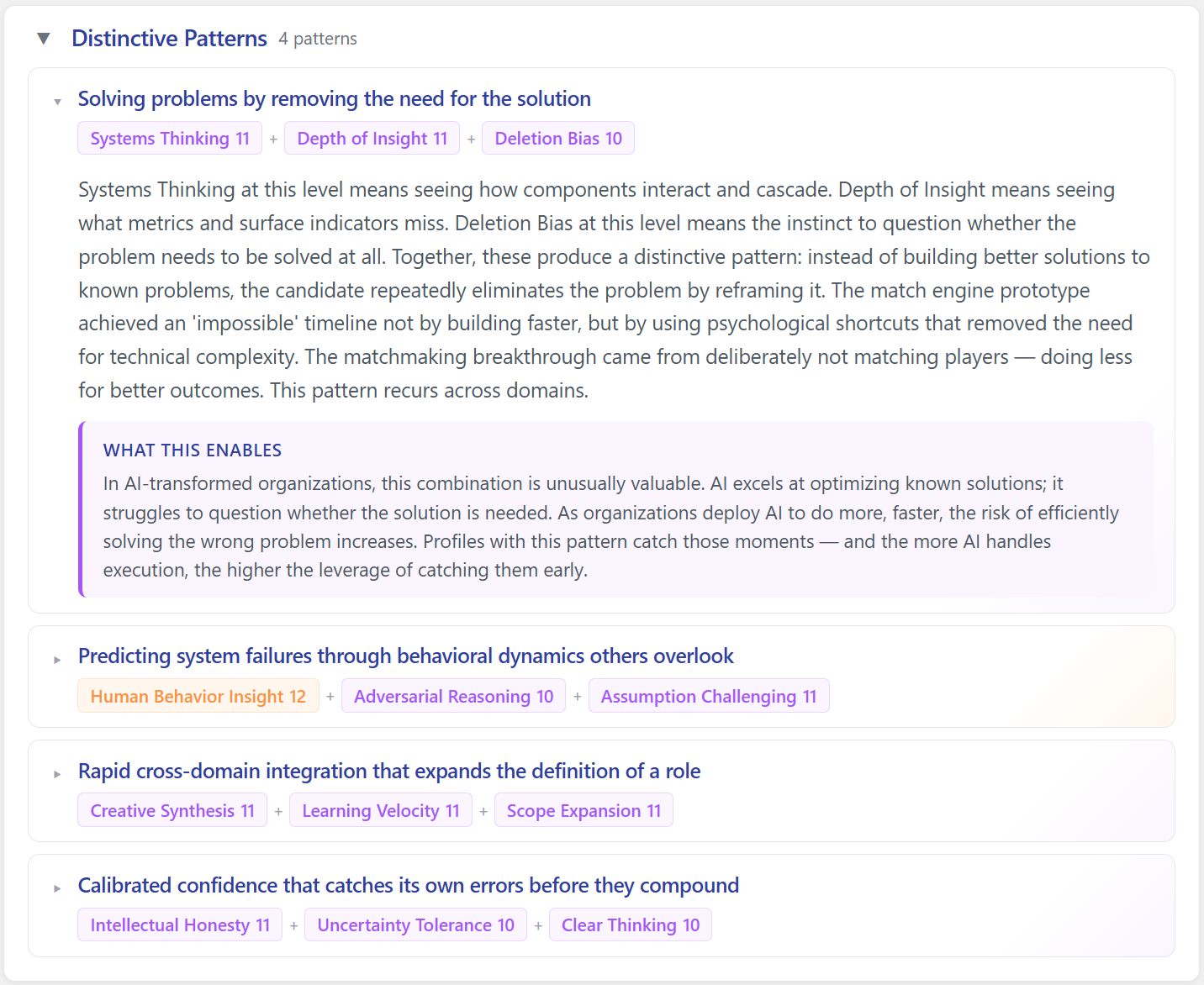
Distinctive Patterns section with one pattern expanded: trait pills with scores, a detailed pattern description, and a 'What This Enables' callout connecting the pattern to AI-era value. Additional collapsed patterns visible beneath.
Most resume keywords name skills the candidate shares with thousands of others. Distinctive Patterns name the combinations only this candidate produces - and what those combinations enable. The patterns often surface capabilities the candidate themselves wouldn't think to put on a resume.
The hires that compound aren't found by matching resumes to roles. They're found by reading the combinations only this person produces.
The score reads outcomes, not credentials. A layperson getting outsized results from simple methods will outscore a credentialed researcher who hasn't shipped - what's being measured is leverage, drawn from work product.
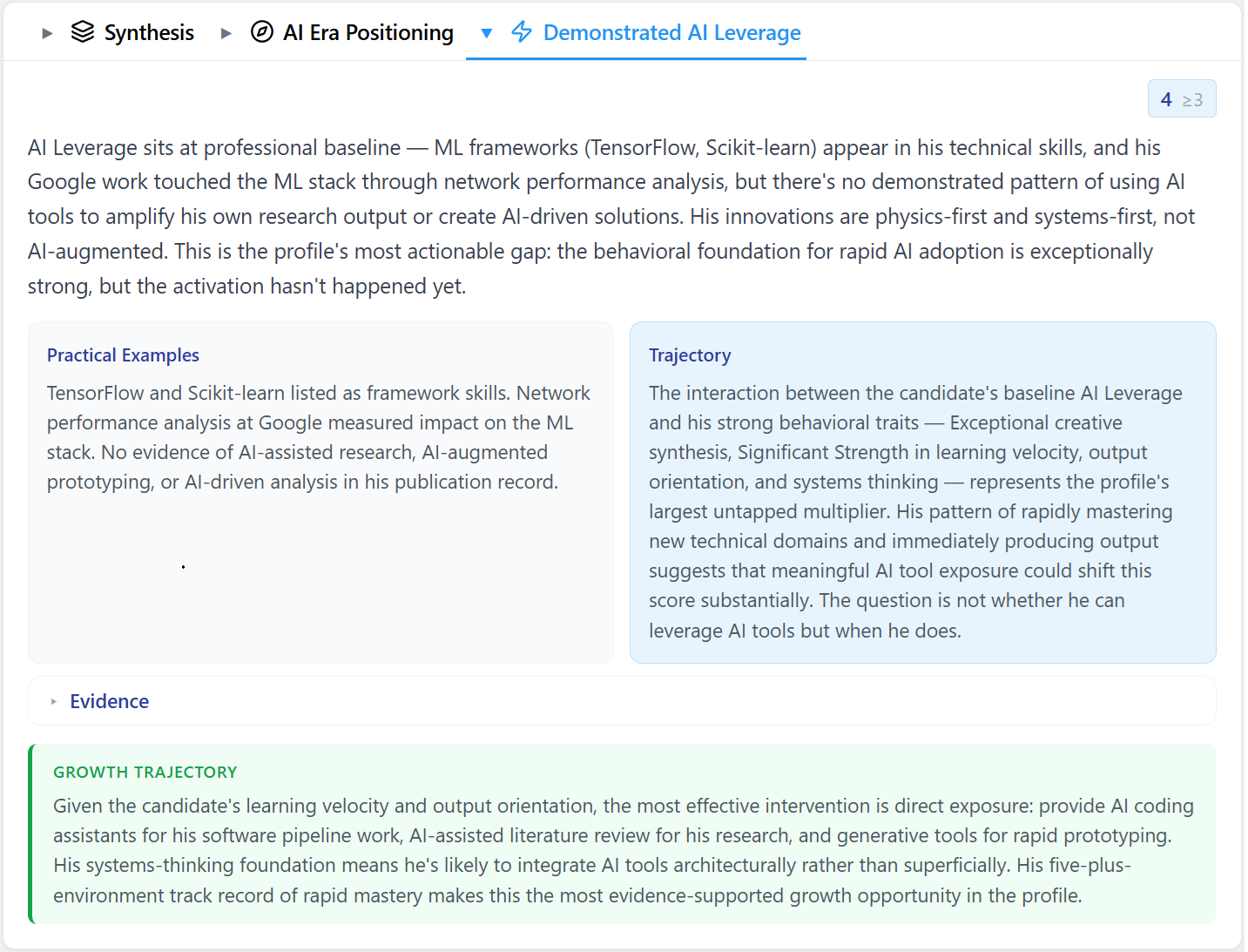
Demonstrated AI Leverage view: current AI Leverage score with Practical Examples box documenting evidence, Trajectory box describing the behavioral foundations that predict rapid adoption capability, and a Growth Trajectory section recommending specific AI exposure to unlock latent potential.
Trajectory reads forward from there: the behavioral foundation specific to this candidate, and what it predicts about how their AI work compounds - including where the outsized growth is still ahead. Growth Trajectory names the specific exposure that would unlock the latent capability fastest, and what return to expect from it.
What they're producing now, and the runway from here. Both read from the work itself.
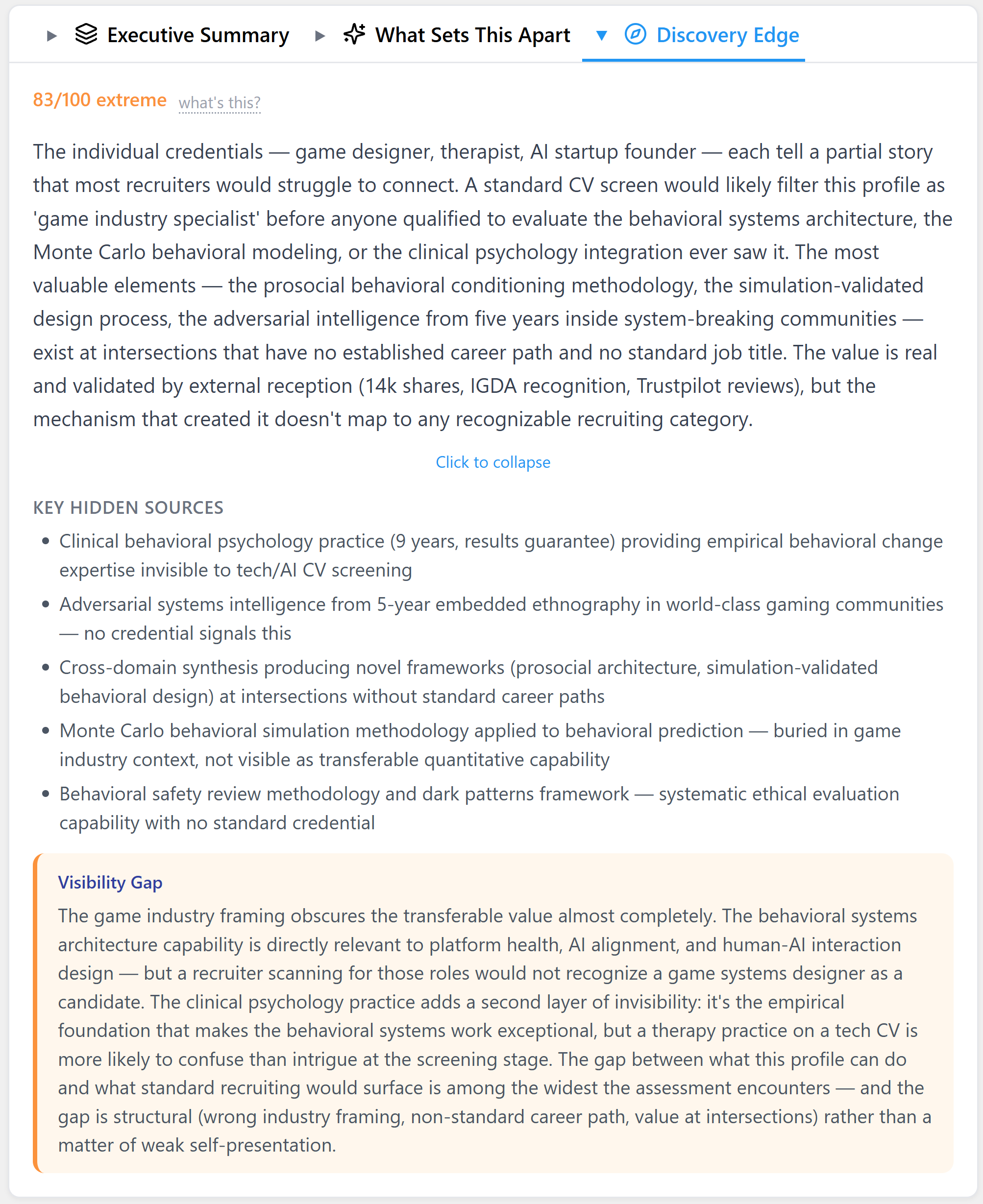
Heimdall reads the work itself. Discovery Edge measures the gap between what's there and what your standard screening would surface. The wider the gap, the larger your information advantage.
Discovery Edge section scored 83/100 'extreme'. Narrative describes how a standard CV screen would filter this profile as a 'game industry specialist' before anyone qualified to evaluate the transferable capabilities ever saw it. Includes Visibility Gap callout and Key Hidden Sources list.
One of the deepest frustrations for outstanding talent is being read by people who can't tell the difference. Above-average and world-class look the same to recruiters who don't know the domain - and to bosses who won't notice when they're coasting or reward them when they ship something extraordinary.

Heimdall gives you the tools to actually see them. The rising-talent discount is real and worth capturing. But the harder thing to compete with is being the rare employer where outstanding people feel recognized. The culture that brings out their best work. That reputation compounds - in who applies, and in who stays.
Most assessment tools rank candidates. Discovery Edge measures, candidate by candidate, what your conventional evaluation misses. No other behavioral assessment quantifies that.
The real decision isn't between Heimdall and another vendor. It's between measuring this and leaving the leverage on the table.
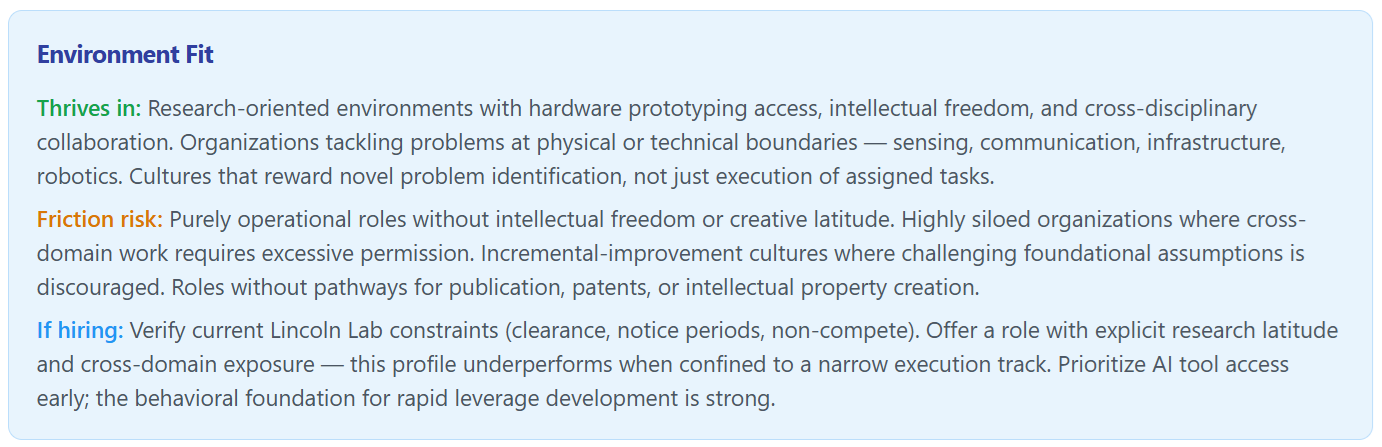
Environment Fit: Thrives in, Friction risk, and If hiring blocks characterising where this person will perform well and where friction emerges. Deployment Notes: candid, specific guidance on how this profile performs when deployed well versus poorly.
This is the question neither party raises in an interview: "Are we actually the right organization for this person?" Heimdall surfaces it because the evidence makes it visible, not because anyone needs to have an uncomfortable conversation.
The most expensive hiring mistakes aren't bad hires. They're good people in wrong environments.
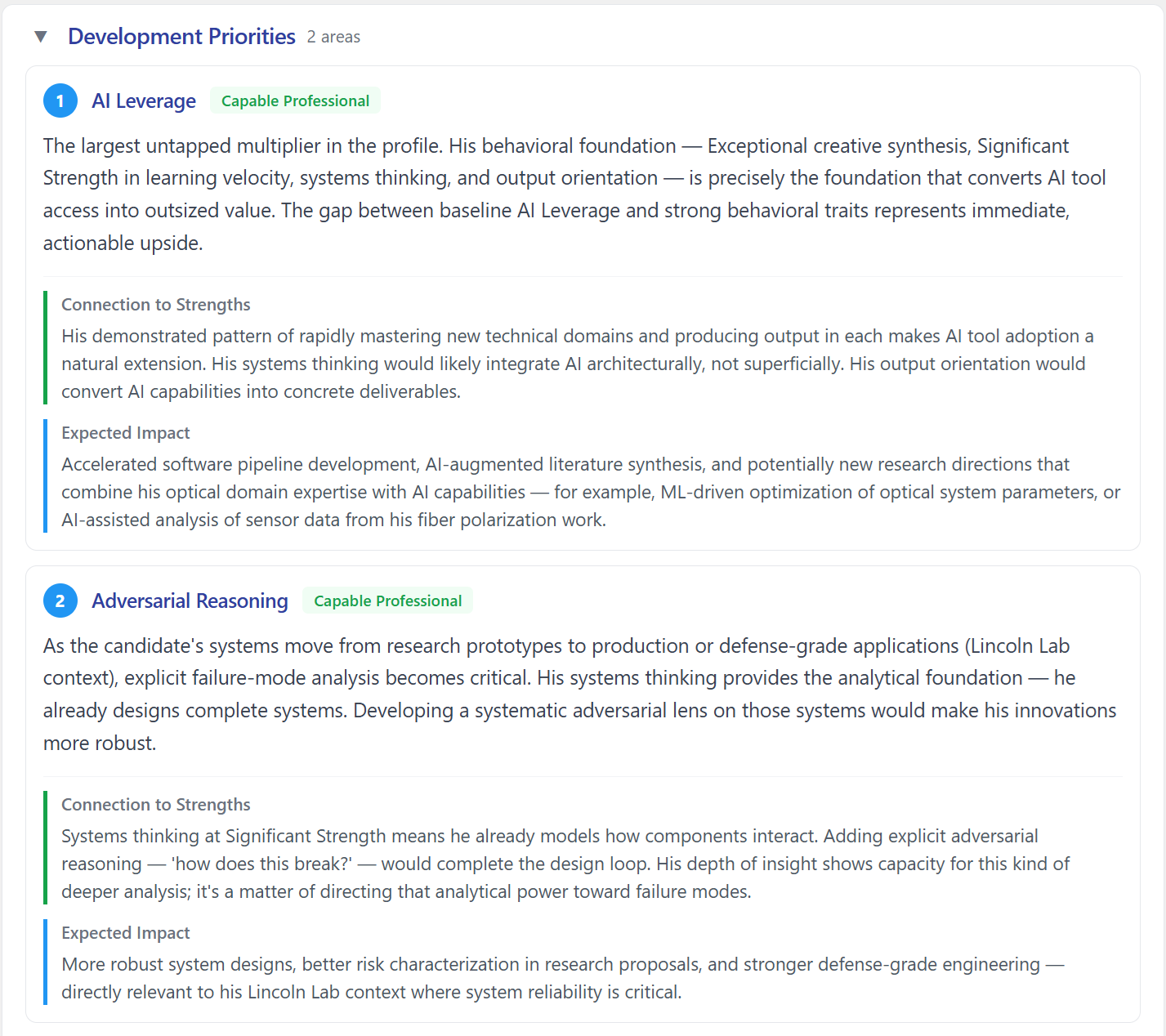
Development Priorities section with numbered priorities: trait name, current level pill, 'why this is a priority' reasoning, and Connection to Strengths / Expected Impact sub-sections explaining what each targeted intervention unlocks.
This isn't a generic "areas for improvement" list. Each priority connects to the profile's specific strengths, showing not just what to develop but why this person's particular behavioral foundation means the return on that investment will be high.
AI Potential isn't fixed. The same evidence that surfaces it also tells you what would grow it.
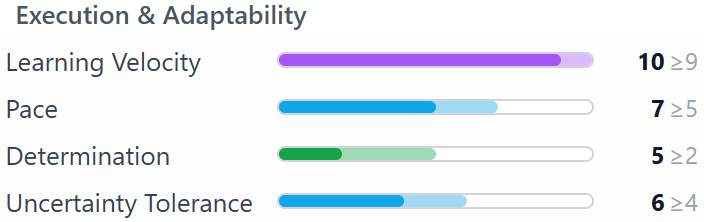
Cropped view of trait bars showing Execution and Adaptability section with Learning Velocity (10 ≥ 9), Pace (7 ≥ 5), Determination (5 ≥ 2), and Uncertainty Tolerance (6 ≥ 4). Each bar has a solid portion (validated floor) and a lighter extended portion (potential), making the gap structure visible at a glance.

Potential: what the evidence suggests this person is capable of.
Floor: what can be defensibly proven from available materials.
The gap: tells you exactly what to explore in the interview.

A small gap means strong evidence supports the score. A large gap means the potential is there but confirmation would strengthen confidence. The validation ratio (e.g., "67% validated") tells you what proportion of scores are fully supported. More materials, tighter validation, smaller gaps.

A CV alone produces a useful assessment with wider gaps. Portfolio materials, recommendations, and performance reviews close them. You decide how much evidence to provide.

The dual scoring system makes uncertainty useful. Instead of hiding what the tool doesn't know, Heimdall shows you exactly where the gaps are, so you know what to explore in an interview, what to validate through references, and what you can trust immediately.
An assessment you can trust is one that tells you what it doesn't know. The gap between potential and floor is your roadmap for follow-up.
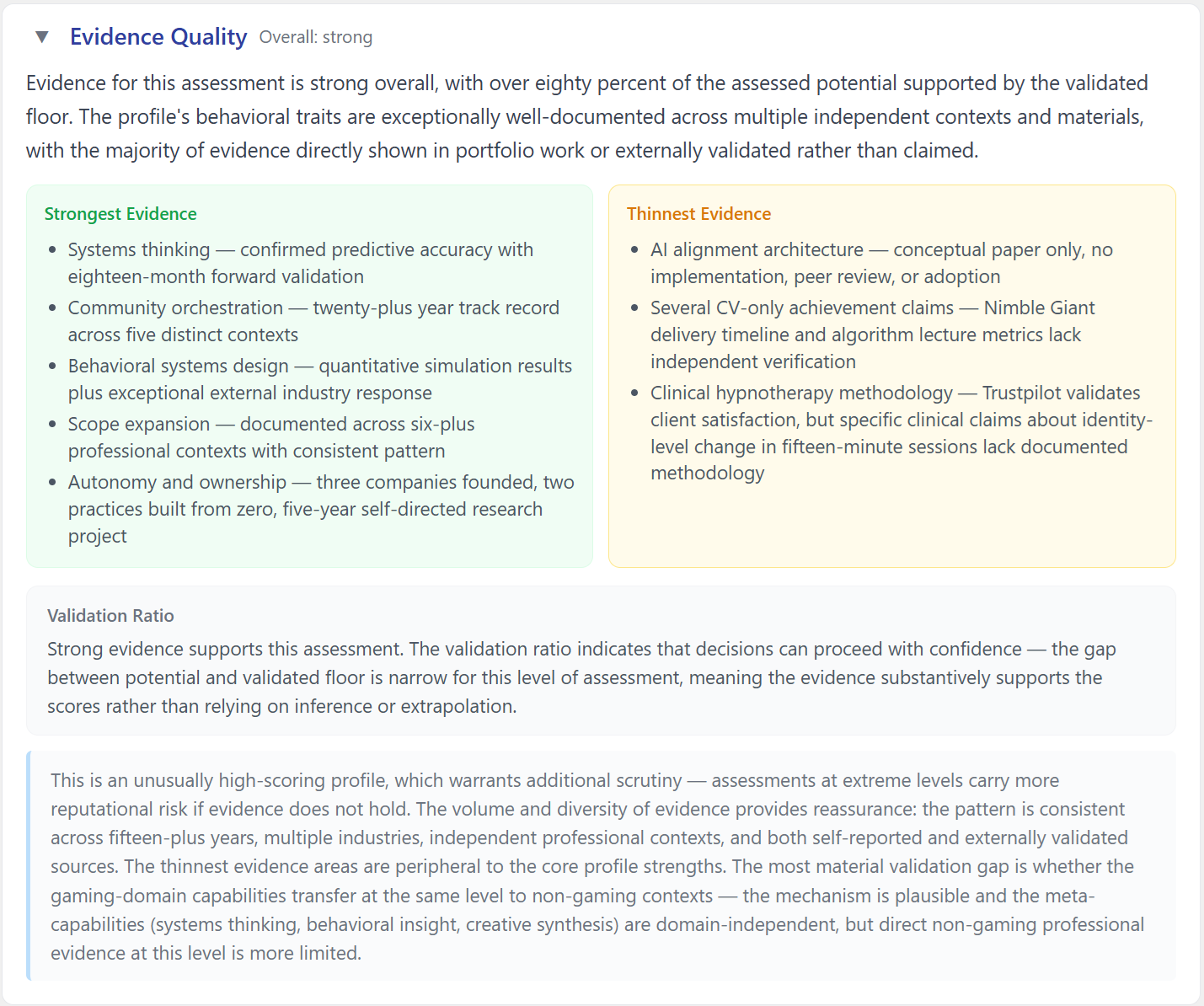
Evidence Quality section with overall rating 'strong'. Strongest Evidence panel (green) lists confirmed predictive accuracy, multi-context track records, and quantitative simulation results. Thinnest Evidence panel (amber) lists conceptual papers without peer review, CV-only achievement claims lacking independent verification, and methodology gaps. Validation Ratio note reports the gap between potential and validated floor as narrow. A confidence note explains that high-scoring profiles warrant additional scrutiny but the volume and diversity of evidence provides reassurance.

Both sides contribute evidence. The employer shares what they have: performance reviews, project notes, private context. The candidate shares what the employer can't see: work samples, recommendations, portfolio. The richer the evidence, the tighter the assessment.

The evidence-based approach matters most for unconventional candidates: career changers, cross-domain experts, people whose value lives at intersections that don't map to standard job titles. Exactly the profiles self-report tools struggle with, because the candidate doesn't have language for what makes them distinctive.
Start with a CV. Add materials as they become available. Each piece narrows the gaps.
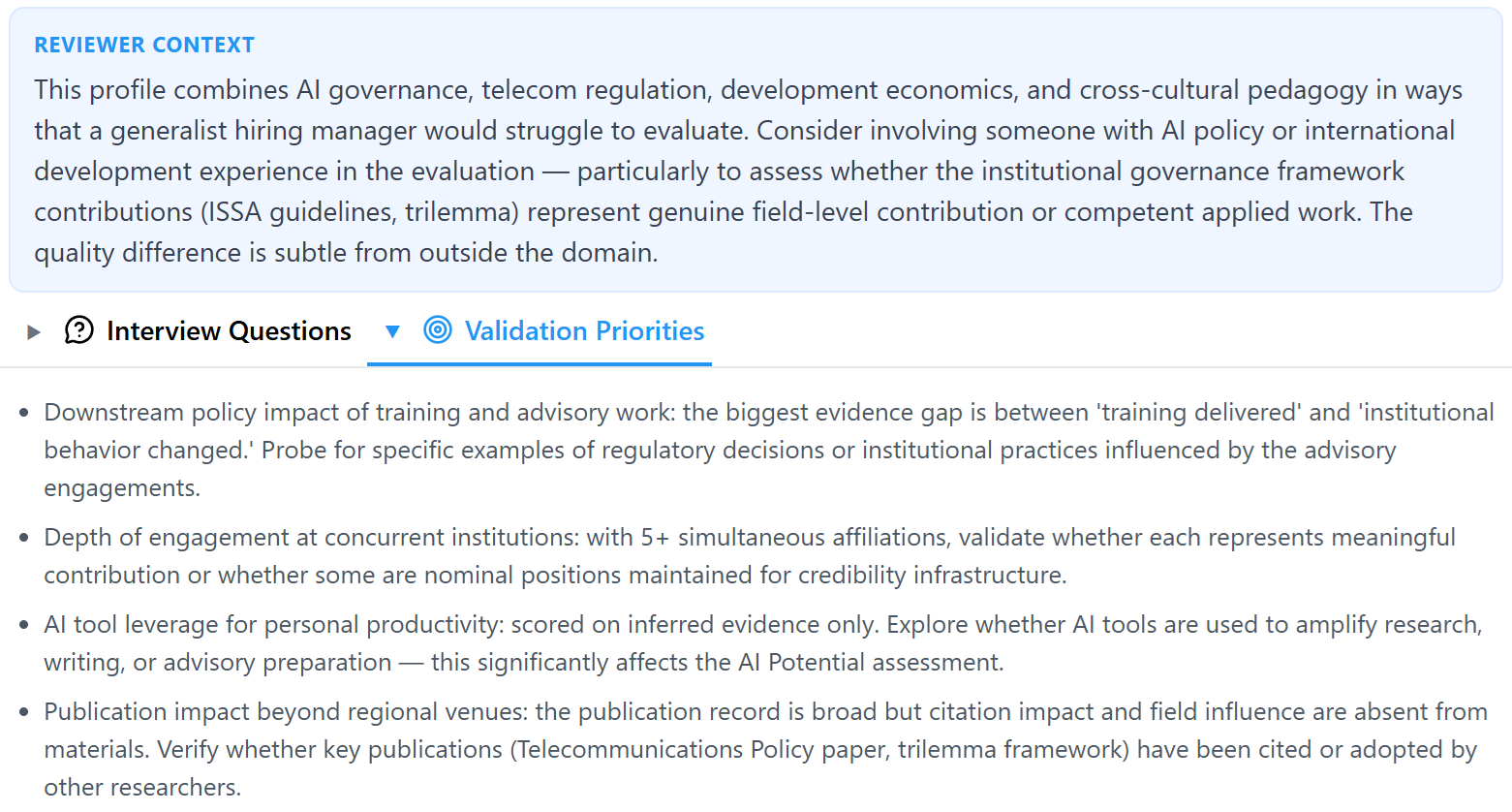
Reviewer Context block recommending who should be involved in the evaluation given the profile's cross-domain range, followed by expanded Interview Questions with 'Listen for' guidance that tells a generalist interviewer what a strong answer looks like versus a weak one.
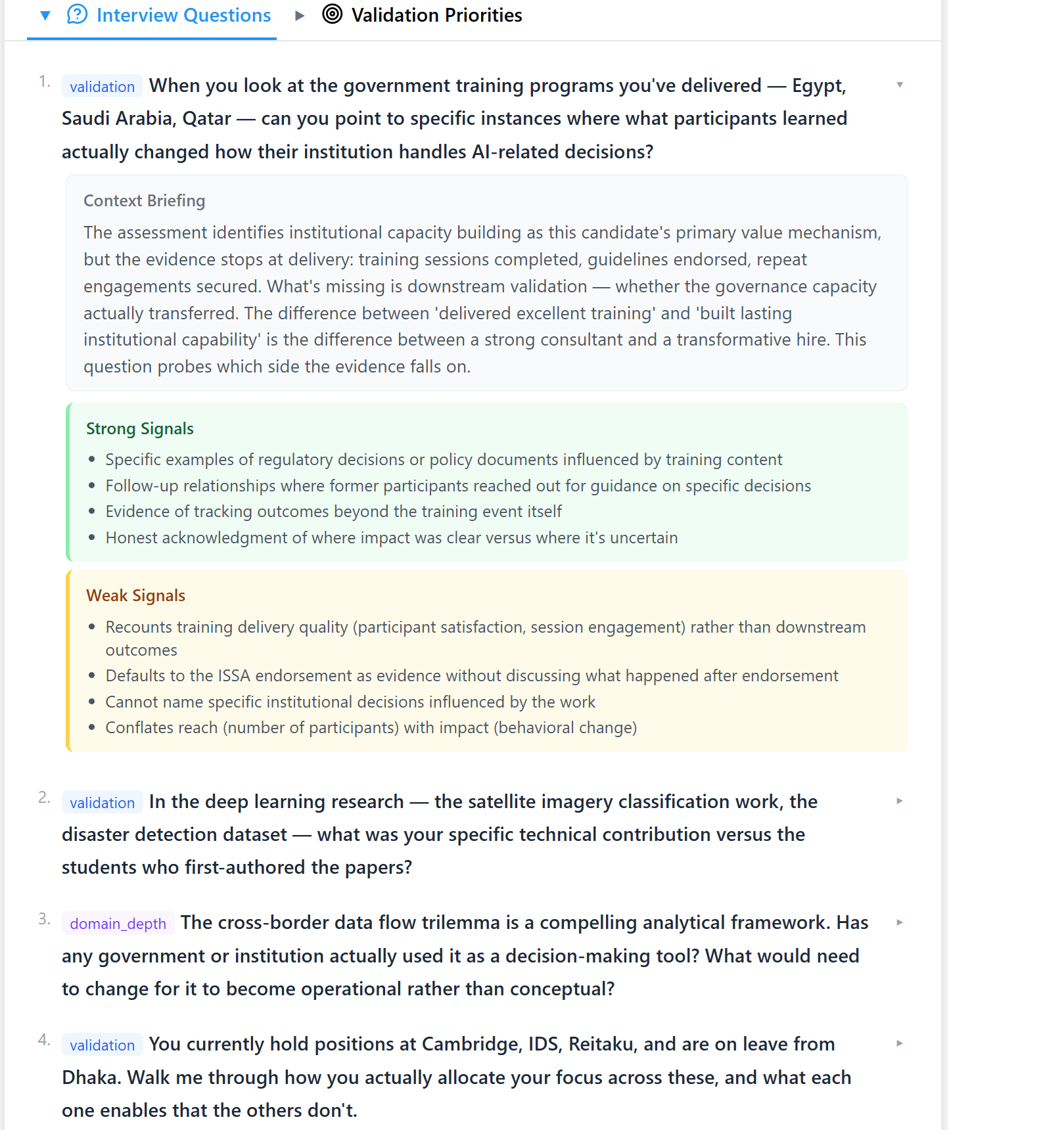
Interview Questions tab showing four numbered validation questions, with the first question expanded. The expanded view includes a Context Briefing explaining why the question matters for this profile, a Strong Signals panel listing what good answers look like, and a Weak Signals panel listing red flags. Each question is tagged by category (validation, domain_depth).
Validation Priorities tell you what's worth verifying about this profile. Interview Questions translate those priorities into specific questions, each with a rubric for what strong versus weak answers look like. A generalist interviewer can validate specialized capabilities because Heimdall briefs them on what to ask and what to listen for.
The interview is where most hiring decisions are actually made. Heimdall makes sure the questions you ask are the ones that matter for this person.

Candidates upload their CV (LinkedIn import available), optionally attach work samples, and optionally answer questions designed to surface abilities they don't expect hiring to recognize. They receive the same rich assessment you do, minus the strategic fields that stay with you (Discovery Edge, interview guidance, your private notes).

When the best candidates have a choice of where to work, the organizations that see and appreciate their distinctive value win. The assessment experience is a first impression, and Heimdall makes it one that exceptional people remember.

Candidate experience isn't a nice-to-have. The people who'd be the most valuable hires also have the most options. Their experience with your assessment is a sample of what working with your company would feel like - and they tell each other about it.
Exceptional people who felt genuinely seen by your assessment become your strongest referral sources. The hiring tool you used becomes part of how your company is described in their networks.

Try it with people you already know.

Start with your current team. People whose capabilities you understand well. See what Heimdall surfaces that you already knew, and what it reveals that you didn't. That's the proof.

You share what you have

  • Choose an employee or applicant to assess
  • Optional: attach 0-20 files such as performance reviews, project notes, interview transcripts, whatever you've got
  • Optional: add private context the candidate won't see

They show what you can't see

  • Upload CV (LinkedIn import available)
  • Optional: attach 0-20 files such as work samples, recommendations, writing, anything goes
  • Optional: answer questions designed to surface abilities they don't expect hiring to recognize

Both get the results

  • You get the full behavioral profile, scores, and evaluation guidance
  • They get the same assessment minus a few strategic fields, designed to make exceptional people feel genuinely seen
Start Free Trial
5 employees · 25 applicants · Full assessments · No credit card
Designed so exceptional talent feel you're seeing and appreciating them.
Top talent has early-bird pricing.
We're built so you can act on it before everyone else does.
The same evidence also produces a Transformation Quotient (TQ) assessment: a broader measure of who will create outsized impact across any role. Every free trial generates both.
Patent pending · Evidence-based: no self-report · Hybrid AI/deterministic architecture